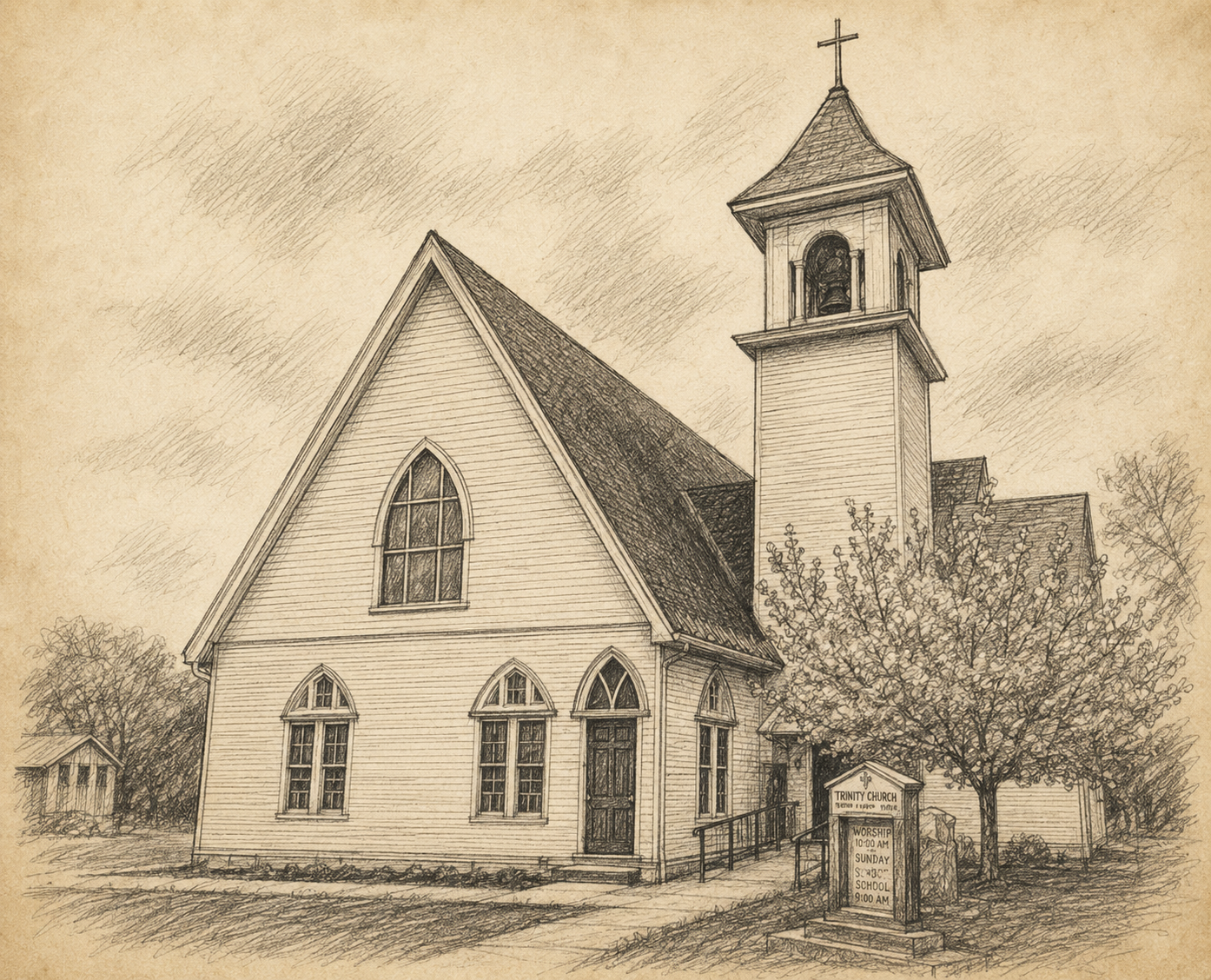
The Gospel Message in Terre Hill
A Small Town, A Mighty God
Edited By: Rev. Neal E Martin, Pastor of Trinity E.C. Church
I. The Earliest Witness: Before the Congregations
The earliest recorded Christian activity in the Terre Hill area predates any formal congregation. In the mid-nineteenth century, when no church building yet stood in the community, a Sunday School was conducted at the Oberholser Schoolhouse under lay leadership, including a man named John Galt. This was no unusual circumstance in rural Pennsylvania. Worship frequently began under tents and open air preaching. Something that remains to this very day.
Itinerant preachers such as Reverend Jacob Burkhart carried the Gospel across these roads in the pattern characteristic of frontier and rural ministry. He preached his first sermon in the Clauser Woods, now the property of our outdoor church pavillion and picnic area. By the 1830’s-1840’s, a church structure had been established in the broader Fairville-Terre Hill region.
These early years established a pattern that would define Terre Hill's religious life for generations: multiple traditions taking root in the same soil. From Mennonites to Methodist Preachers and Evangelical Revivalists, all proclaimed “A mighty God, in a small town”.
II. The Mennonite-Revival Stream
Terre Hill Bible Fellowship Church
One of the earliest clearly documented spiritual movements in the Fairville area began in 1858, among Old Order Mennonite believers whose hunger for revival had grown beyond what existing structures could accommodate. Prayer meetings held in private homes eventually gave rise to a separation from established Mennonite fellowship.
This led to the formation of a more renewal-oriented community, known as the Evangelical Mennonites.
The congregation met in informal settings — including, at one point, a converted stable — sustained not by institutional resources but by the conviction that the Gospel required living response. The influence of William Gehman and the Evangelical United Mennonites gave this movement greater coherence and doctrinal shape, eventually developing through the Mennonite Brethren in Christ into the tradition now known as the Bible Fellowship Church. The Terre Hill expression of this stream maintained its own distinct congregational life, separate from the Evangelical Association churches across town.
That heritage continues today in the Terre Hill Bible Fellowship Church — a congregation that carries the marks of that 1858 awakening among plain-faith believers who found the living God.
III. The Evangelical Association Stream
Trinity E.C. Church & St. Paul's Methodist
A second and distinct stream of Christian witness came to Terre Hill through the Evangelical Association, founded in 1800 by Jacob Albright among Pennsylvania German communities. Albright's movement was shaped by Methodist theology and practice — its hallmarks were circuit-riding ministry, revivalist preaching, and an urgent appeal to personal faith. The Evangelical Association spread rapidly through German-speaking Pennsylvania, carrying the Gospel into communities where it could be proclaimed in the language of the home as well as the heart.
By the latter decades of the nineteenth century, Evangelical Association work had established itself in the Terre Hill area. Early ministry followed familiar patterns — Sunday School work in local schoolhouses, revival services by itinerant ministers, the slow and patient building of a worshiping community.
The Division of the 1890s
The fracturing of the Evangelical Association in the 1890s also had it’s impact on Terre Hill. What divided the denomination and the church was a predominant question on church governance: specifically, the authority in episcopal leadership versus the rights of local conferences and congregations.
In Terre Hill, as across Pennsylvania, this division produced separate congregational paths from what had been a shared Evangelical heritage. One line of succession eventually carried Trinity into the Evangelical Congregational tradition. Another flowed through later denominational mergers into The Methodist Church.
On October 1, 1894 — in the midst of a significant change Bishop C.S. Haman laid the cornerstone of what would become Trinity E.C Church. Reverend A.J. Brunner served as an early pastor during a particularly formative period, shepherding the congregation through its years of organization and growth. For a time, the congregation worshipped in the Terre Hill Band Hall until a church could be built.
Revival meetings continued under Reverend Brunner's leadership. The building was completed and dedicated in 1895, establishing what is now known as Trinity Evangelical Congregational Church.
Across the road, a congregation that developed from within the same broad Evangelical stream eventually found its identity in what is now St. Paul's Methodist Church. The presence of these two congregations on the same street, sharing a common ancestry yet belonging to distinct traditions is still seen to this day.
IV. A Shared Heritage
It is one of the features of Terre Hill's religious history that though different traditions diverged, the congregations nevertheless retained a profound commonality of spiritual revival. Both the Mennonite-revival stream and the Evangelical Association stream were formed in the crucible of nineteenth-century revivalism. These churches were shaped by:
Camp meetings held in wooded groves, houses and community buildings, the priority of worship, bible study and a call to repentance.
Outdoor preaching and tent services that drew whole communities together across denominational lines
This shared heritage has not been lost. In Terre Hill today, congregations that developed along separate historical paths nonetheless come together for community-wide worship gatherings — outdoor services and joint meetings that carry, whether consciously or not, the character of those earliest revival assemblies.
There is something fitting in this. The faith of Terre Hill did not begin inside any single building. It began in schoolhouses and fields and converted stables, among people of varied backgrounds who recognized in one another a common allegiance to one Lord.
Together, and sometimes separately, these congregations have continued for generations to do what the first believers in Terre Hill did in that Oberholser schoolhouse: gather the community, open the Scriptures, and bear witness to the Gospel of Jesus Christ.
Trinity Evangelical Congregational Church:
A Continuing Story
Within this larger narrative, Trinity Evangelical Congregational Church understands itself not as the conclusion of a history, but as a present chapter in a story still being written.
Trinity is a congregation shaped by its heritage — by the Evangelical Association's commitment to Gospel proclamation, by the revivalist conviction that faith must be alive and personal, by the Evangelical Congregational tradition's long effort to hold a high view of scripture along with a missionary zeal to proclaim the gospel message. That heritage is not merely commemorated here. It is, by the grace of God, continued.
Trinity's calling, as it has always been, is to abide faithfully in Christ, to serve the community in love, and to remain connected to the broader work of the Evangelical Congregational Church — a denomination that has itself sought, across its own long history, to keep the Gospel central and the mission urgent.
Looking Forward
A community's religious history is never simply the record of what has passed. It is, for those who stand within it, a testimony — evidence of what God has done, and therefore ground for confidence about what He may yet do.
The spiritual streams that converged in Terre Hill did not arrive by accident. They came carried by men and women who believed the Gospel was worth passing on, carefully and faithfully, to the next generation.
The heritage is alive. The witness goes on. And the same Gospel that was first preached in this valley in schoolhouses and fields remains, as it has always been, the foundation upon which everything else is built.
Our heritage is not merely history — it is a living testimony. The same Spirit who stirred revival in past generations continues to call us to faithfulness today.
As we abide in Christ, serve with love, and go with missionary zeal, we join the ongoing story of God’s redeeming work in the world.
When God gets ready to shake America, He may not take the Ph.D. and the D.D. God may choose a country boy ... God may choose the man that no one knows, a little nobody, to shake America for Jesus Christ in this day, and I pray that He would!
~Billy Graham